
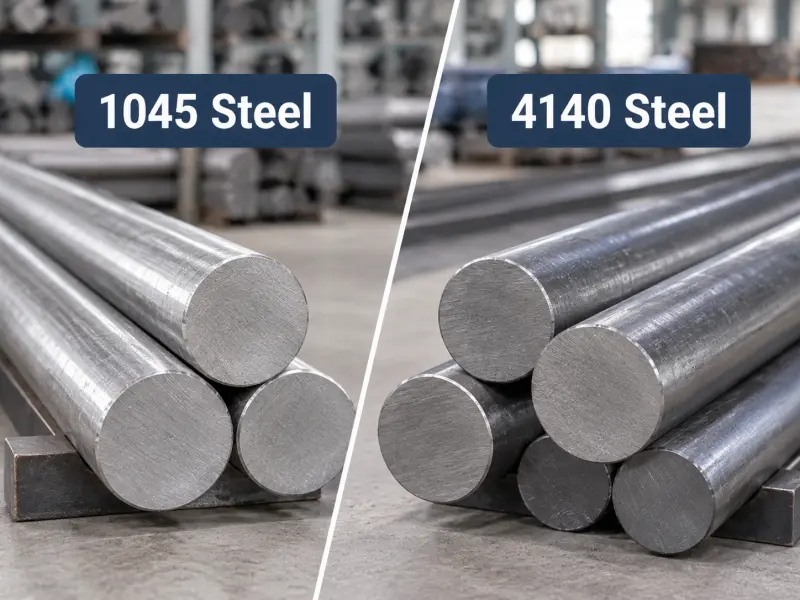
1045 vs 4140 steel is a common comparison when sourcing steel for shafts, gears and industrial machinery components. Both grades are used for mechanical parts, but 1045 is a medium carbon steel, while 4140 is a chromium-molybdenum alloy steel. Their main differences are chemical composition, strength, hardness and hardenability. The right choice depends on component dimensions, operating loads and required heat treatment.
1. 1045 vs 4140 Steel: Key Differences
| Comparison | 1045 Steel | 4140 Steel |
|---|---|---|
| Steel Type | Medium Carbon Steel | Cr-Mo Alloy Steel |
| Carbon Content | 0.43–0.50% | 0.38–0.43% |
| Main Alloy Elements | Carbon, Manganese | Chromium, Molybdenum, Manganese |
| Tensile Strength (Normalized Reference) | 710 MPa | 1,020 MPa |
| Yield Strength (Normalized Reference) | 413 MPa | 655 MPa |
| Hardness (Normalized Reference) | 218 HV10 | 302 HB |
| Hardenability | Moderate to low | High |
| Heat Treatment | Normalizing, quenching and tempering | Annealing, normalizing, quenching and tempering |
| Typical Applications | Shafts, pins, axles, machinery parts | Gears, heavy-duty shafts, transmission components |
| Relative Material Cost | Generally lower | Generally higher |
Mechanical property references are from specific published test conditions, not universal grade minimums. The 1045 values represent a normalized 20 mm round bar; the 4140 values represent material normalized at 870°C. Hardness values use different scales and are not directly equivalent.
The main difference in 4140 vs 1045 steel is hardenability. Although 1045 has slightly higher carbon content, the chromium and molybdenum in 4140 allow it to develop a hardened structure more effectively through larger cross-sections.
2. Chemical Composition of 1045 and 4140 Steel
The chemical composition of 1045 and 4140 steel determines their different responses to heat treatment.
| Element (%) | 1045 Steel | 4140 Steel |
|---|---|---|
| Carbon (C) | 0.43–0.50 | 0.38–0.43 |
| Manganese (Mn) | 0.60–0.90 | 0.75–1.00 |
| Silicon (Si) | 0.15–0.35 | 0.15–0.35 |
| Chromium (Cr) | Residual level | 0.80–1.10 |
| Molybdenum (Mo) | Residual level | 0.15–0.25 |
| Phosphorus (P) | ≤0.040 | ≤0.035 |
| Sulfur (S) | ≤0.050 | ≤0.040 |
Typical SAE/AISI grade reference ranges. Confirm applicable product specifications and MTC values for actual chemical limits.
The key differences are:
- Carbon: Both grades contain medium carbon levels, contributing to strength and hardness.
- Chromium: Improves hardenability and wear resistance in 4140.
- Molybdenum: Improves hardenability and helps maintain strength after tempering.
Despite its slightly higher carbon content, 1045 does not achieve the same through-hardening capability as 4140 steel, because it lacks the intentional chromium and molybdenum alloy additions.
3. 1045 vs 4140 Steel: Strength, Hardness and Hardenability
The 1045 vs 4140 strength and hardness comparison depends on delivery condition and section size.
Mechanical Properties by Condition
| Condition | Property | 1045 Steel | 4140 Steel |
|---|---|---|---|
| Annealed Reference | Tensile Strength | 585 MPa | 655 MPa |
| Annealed Reference | Yield Strength | 505 MPa | 417 MPa |
| Annealed Reference | Elongation | 12% | 25.7% |
| Annealed Reference | Hardness | 170 HB | 197 HB |
| Normalized Reference | Tensile Strength | 710 MPa | 1,020 MPa |
| Normalized Reference | Yield Strength | 413 MPa | 655 MPa |
| Normalized Reference | Elongation | 23.5% | 17.7% |
The annealed 1045 figures represent cold-drawn, annealed round bar (19–32 mm); the 4140 figures represent annealing at 815°C. The normalized 1045 figures represent a 20 mm round bar; the 4140 figures represent normalization at 870°C. These are published reference results from different test conditions, not a standardized head-to-head test.
Key Performance Differences
| Property | 1045 Steel | 4140 Steel |
|---|---|---|
| Strength Potential | Suitable for general mechanical loads | Higher potential after heat treatment |
| Surface Hardening | Suitable for induction and flame hardening | Suitable for induction and conventional hardening |
| Hardenability | More limited in larger sections | Better through-section hardening |
| Core Strength | More limited in heavy sections | Better potential in larger sections |
| Toughness | Suitable for general applications | Good strength-toughness balance after proper Q&T |
Hardenability is not the same as hardness. Hardness measures resistance to indentation, while hardenability describes how deeply a steel can develop a hardened structure during quenching.
This is why 4140 is often preferred for larger shafts and high-load components, even though 1045 can also achieve high surface hardness.
4. Heat Treatment Differences Between 1045 and 4140
Both grades can be supplied in annealed, normalized and quenched-and-tempered conditions, but their typical processing temperatures differ.
| Heat Treatment Parameter | 1045 Steel | 4140 Steel |
|---|---|---|
| Annealing Temperature | 800–850°C | 680–720°C |
| Normalizing Temperature | 850–920°C | 840–880°C |
| Austenitizing / Hardening Temperature | 800–850°C | 830–860°C |
| Typical Quenching Medium | Water or oil, depending on section and procedure | Oil |
| Tempering Temperature | 400–650°C | 540–680°C |
Typical processing references, not fixed production instructions. Actual heat treatment depends on section dimensions, required hardness and processing procedures.
Common delivery conditions:
- Annealed: Lower hardness and improved machinability.
- Normalized: Refined structure and more uniform mechanical properties.
- Quenched and Tempered: Higher strength and hardness with controlled toughness.
For procurement, specify the required delivery condition, hardness and mechanical properties instead of simply requesting heat-treated 1045 or 4140.
5. Applications of 1045 vs 4140 Steel
The choice between 1045 and 4140 steel for shafts, gears and machinery components depends on operating loads, component dimensions and heat treatment requirements.
| Application | Commonly Selected Grade | Reason |
|---|---|---|
| General Machinery Shafts | 1045 | Suitable for standard mechanical loads |
| Pins and Studs | 1045 | Practical medium-carbon steel option |
| Hydraulic Piston Rods | 1045 | Suitable for many general-duty applications |
| Industrial Transmission Gears | 4140 | Better hardenability |
| Heavy-Duty Drive Shafts | 4140 | Higher strength potential after Q&T |
| Large Mechanical Spindles | 4140 | Better through-section hardening |
| High-Load Machinery Parts | 4140 | Suitable for demanding mechanical conditions |
1045 is a practical choice when its strength and hardness meet the design requirements. 4140 is generally more suitable when higher core strength, better hardenability or improved performance after quenching and tempering is required.
6. How to Choose Between 1045 and 4140 Steel
Use the following purchasing considerations when deciding which is better, 1045 or 4140 steel.
| Purchasing Requirement | Recommended Grade |
|---|---|
| General mechanical components | 1045 |
| Standard shafts and pins | 1045 |
| Lower material cost | 1045 |
| Higher through-hardening requirements | 4140 |
| Larger cross-section components | 4140 |
| Heavy-duty transmission components | 4140 |
| Higher strength after Q&T | 4140 |
Before requesting a quotation, confirm:
- Grade: AISI 1045 or AISI 4140.
- Product form: Round bar, flat bar, plate or seamless tube.
- Dimensions: Diameter, thickness, width and length.
- Delivery condition: Hot rolled, annealed, normalized or quenched and tempered.
- Mechanical requirements: Hardness, tensile strength and yield strength.
- Documentation: Material Test Certificate (MTC) and agreed inspection requirements.
For general-purpose medium carbon steel, 1045 steel products offer a cost-effective solution for many machining applications. For components requiring higher hardenability and more demanding mechanical performance, 4140 steel products are generally the more suitable option.
We supply 1045 steel and 4140 steel in round bars, flat bars, plates and seamless tubes. Available dimensions, delivery conditions and order quantities can be discussed according to purchasing requirements.