
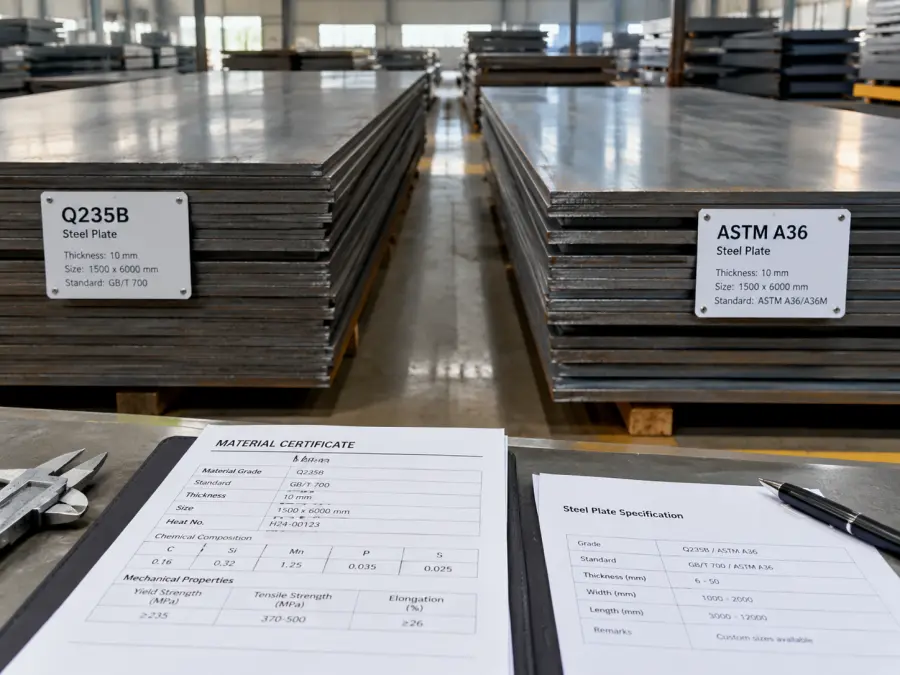
Q235B vs A36 steel is a common comparison for buyers sourcing carbon structural steel. Although both grades are widely used for structural fabrication and construction projects, they are produced according to different standards and are not completely equivalent.
This guide explains the key differences between Q235B and ASTM A36, including mechanical properties, material equivalence and how to choose the right grade for your project.
Q235B vs A36 Steel: Key Differences at a Glance
The main difference between Q235B and A36 steel is the standard they follow and their specified mechanical requirements.
| Item | Q235B | ASTM A36 |
|---|---|---|
| Standard | GB/T 700 | ASTM A36/A36M |
| Steel Type | Carbon structural steel | Carbon structural steel |
| Yield Strength | ≥235 MPa | ≥250 MPa |
| Tensile Strength | 370-500 MPa | 400-550 MPa |
| Carbon Content | ≤0.20% | ≤0.26% |
| Impact Requirement | +20°C Charpy impact test | Depends on specification |
| Common Forms | Plate, coil, sections | Plate, sections, bars |
For general structural applications, both Q235B steel and ASTM A36 steel provide good weldability and machinability. However, ASTM A36 has a slightly higher minimum yield strength, which may affect material selection for projects with specific design requirements.
Q235B vs ASTM A36: Are They Equivalent?
One of the most common questions from international buyers is whether Q235B is equivalent to A36 steel.
The answer is that Q235B and ASTM A36 are not identical grades. They are manufactured according to different standards, with differences in mechanical requirements, chemical composition limits and certification systems.
However, Q235B can be considered a practical equivalent material to ASTM A36 in some general structural applications when:
- The required strength meets the project specification
- The customer accepts alternative material standards
- The application does not require a specific ASTM grade
- Material certificates and inspection documents are approved
For international steel procurement, buyers should confirm the required standard before replacing ASTM A36 with Q235B.
Q235B vs A36 Mechanical Properties Comparison
The mechanical properties of Q235B and A36 are an important factor when evaluating whether one grade can replace another.
| Property | Q235B | ASTM A36 |
|---|---|---|
| Yield Strength | ≥235 MPa | ≥250 MPa |
| Tensile Strength | 370-500 MPa | 400-550 MPa |
| Elongation | ≥26% | ≥20% |
From a strength perspective, A36 steel has a higher specified minimum yield strength than Q235B. However, the actual suitability depends on the application, thickness, design requirements and project standards.
For buyers comparing Q235B vs A36 yield strength, the difference is important, but it should not be the only factor considered during material selection.
Q235B vs A36 Chemical Composition Comparison
The chemical composition of Q235B and A36 also differs slightly due to different standards.
| Element | Q235B | ASTM A36 |
|---|---|---|
| Carbon (C) | ≤0.20% | ≤0.26% |
| Silicon (Si) | ≤0.35% | ≤0.40% |
| Manganese (Mn) | ≤1.40% | ≤1.20% |
| Phosphorus (P) | ≤0.045% | ≤0.040% |
| Sulfur (S) | ≤0.045% | ≤0.050% |
The exact chemical requirements may vary depending on product thickness and supply conditions. For purchasing decisions, buyers should check the mill test certificate (MTC) to confirm the supplied material meets the required standard.
Can Q235B Replace A36 Steel?
The question “Can Q235B replace A36 steel?” depends on the project requirements rather than only the material name.
Q235B may be suitable when:
- The project accepts GB/T standards
- General structural applications are involved
- The required mechanical properties are satisfied
- The customer approves the alternative grade
ASTM A36 is preferred when:
- Project drawings specify ASTM standards
- The end customer requires ASTM-certified materials
- Engineering calculations are based on A36 properties
Buying Q235B or ASTM A36 Steel Plate
When purchasing structural steel internationally, grade comparison is only one part of the decision. Buyers should also confirm:
- Steel standard and grade
- Thickness and dimensions
- Mechanical property requirements
- Material certificates
- Cutting or processing requirements
- Export documentation
Shuang’ao supplies commonly requested structural steel products, including:
Available supply can include different thicknesses, sizes and processing options according to purchasing requirements.
If you are comparing Q235B vs A36 steel for a specific project, provide your required standard, dimensions and application details to confirm the suitable material option.
FAQ About Q235B vs A36 Steel
Is Q235B equivalent to A36 steel?
Q235B is not exactly equivalent to ASTM A36, because they follow different standards. However, they may be considered alternatives for certain general structural applications when mechanical requirements and project approvals are satisfied.
Can Q235B replace ASTM A36?
Q235B can replace ASTM A36 in some applications, but the replacement should be confirmed according to project specifications, customer requirements and material certification needs.
Which is stronger, Q235B or A36?
In terms of minimum specified yield strength, ASTM A36 is slightly stronger than Q235B. However, the better choice depends on the application, required standards and engineering requirements.