
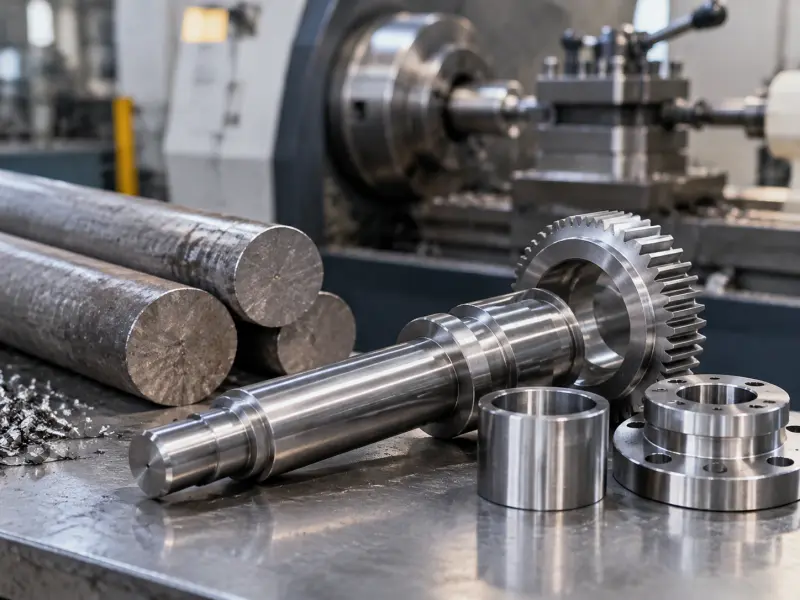
When comparing 1018 vs 1045 steel, the main differences are carbon content, strength, hardness, and heat treatment response. 1018 is a low carbon steel with better weldability and formability, while 1045 is a medium carbon steel offering higher strength and greater hardening potential.
The right choice depends on whether your application prioritizes machinability and fabrication or higher mechanical strength and wear resistance.
1018 vs 1045 Steel: Chemical Composition
The most significant difference between 1018 and 1045 steel is carbon content. 1045 contains more than twice the carbon of 1018, resulting in different mechanical properties and heat treatment capabilities.
| Chemical Composition (%) | 1018 Steel | 1045 Steel |
|---|---|---|
| Carbon (C) | 0.15–0.20 | 0.43–0.50 |
| Manganese (Mn) | 0.60–0.90 | 0.60–0.90 |
| Phosphorus (P) | ≤0.040 | ≤0.040 |
| Sulfur (S) | ≤0.050 | ≤0.050 |
Values are typical reference ranges. Confirm the applicable material specification for actual purchasing requirements.
Key differences:
- 1018: Lower carbon content, better weldability and formability.
- 1045: Higher carbon content, greater strength and hardness potential.
1018 vs 1045: Mechanical Properties
When comparing 1018 vs 1045 strength and hardness, 1045 generally provides higher mechanical strength and hardness in comparable supply conditions.
| Mechanical Properties | 1018 Steel | 1045 Steel |
|---|---|---|
| Tensile Strength | 400–500 MPa | 570–700 MPa |
| Yield Strength | 220–370 MPa | 300–450 MPa |
| Elongation | 15–25% | 12–20% |
| Brinell Hardness | 115–150 HB | 170–210 HB |
These are indicative reference ranges, not guaranteed specification values. Actual properties depend on hot-rolled, cold-drawn, normalized, or heat-treated conditions.
What do these differences mean?
- Strength: 1045 is generally preferred for components requiring higher tensile strength.
- Hardness: 1045 achieves higher hardness, particularly after suitable heat treatment.
- Ductility: 1018 generally offers better formability and elongation.
For mechanical components exposed to higher loads or friction, 1045 is often the more suitable option.
1018 vs 1045: Hardness and Heat Treatment
Heat treatment is a major difference between these two carbon steel grades.
| Factor | 1018 Steel | 1045 Steel |
|---|---|---|
| Through Hardening | Limited response | Better response |
| Quenching and Tempering | Limited effectiveness | Commonly used |
| Induction Hardening | Limited | Suitable |
| Carburizing | Suitable | Less commonly selected |
| Surface Hardness | Can be improved by carburizing | Can be improved by induction hardening |
1018 vs 1045 hardness: 1045 has a higher carbon content, allowing it to achieve greater hardness through quenching and other heat treatment processes.
1018 is more suitable for carburized components requiring a hard surface and relatively softer core. 1045 is preferred for shafts, gears, and other parts requiring higher overall strength or localized surface hardening.
The achievable hardness and hardening depth depend on component dimensions and heat treatment parameters.
1018 vs 1045: Machinability and Weldability
Both grades can be machined using conventional turning, milling, and drilling processes. However, their fabrication characteristics differ.
| Processing Factor | 1018 Steel | 1045 Steel |
|---|---|---|
| Machinability | Good | Good, condition-dependent |
| Weldability | Excellent | More demanding |
| Formability | Better | More limited |
| Cold Working | Better | More limited |
| Heat Treatment Response | Limited through-hardening | Better |
Main differences:
- Machinability: Both are machinable, but 1018 is generally preferred for general-purpose fabrication. Actual cutting performance depends on supply condition.
- Weldability: 1018 is easier to weld. 1045 requires more careful control of preheating, cooling, and welding procedures.
- Formability: 1018 is better suited to applications requiring forming or bending.
For welded and fabricated components, 1018 is generally the more practical choice. For heat-treated mechanical parts, 1045 offers greater flexibility.
1018 vs 1045 Steel: Applications and Common Uses
The difference in strength, hardness, and processing requirements determines where each grade is commonly used.
| Application | 1018 Steel | 1045 Steel |
|---|---|---|
| General Machined Parts | ✓ | ✓ |
| Pins and Fasteners | ✓ | ✓ |
| Welded Components | ✓ | — |
| Machine Shafts | ✓ | ✓ |
| Gears and Sprockets | — | ✓ |
| Axles and Crankshafts | — | ✓ |
| Induction-Hardened Parts | Limited | ✓ |
1018 steel products are generally preferred for:
- General-purpose machined components
- Welded parts and fabricated assemblies
- Pins, fasteners, and spacers
1045 steel products are generally preferred for:
- Machine and transmission shafts
- Gears and sprockets
- Axles and mechanical components requiring higher hardness
These are typical application preferences rather than exclusive material limitations. Final selection should follow the component’s design and performance requirements.
1018 vs 1045: Which Steel Should You Choose?
The choice between 1018 and 1045 steel depends on the required mechanical properties and processing conditions.
| Your Requirements | Better Choice |
|---|---|
| Better weldability | 1018 |
| Better formability | 1018 |
| General machining and fabrication | 1018 |
| Higher tensile strength | 1045 |
| Higher hardness potential | 1045 |
| Quenching and tempering | 1045 |
| Induction hardening | 1045 |
| Shafts and gears requiring higher hardness | 1045 |
Can 1045 Replace 1018 Steel?
1045 can replace 1018 in some applications where higher strength or hardness is required. However, it is not a direct substitute in every case.
Its higher carbon content changes welding requirements, machinability, and heat treatment behavior. Similarly, replacing 1045 with 1018 may reduce the strength and hardness of the finished component.
Before substituting one grade for another, compare the required strength, hardness, dimensions, welding requirements, and supply condition.
Ultimately, 1018 is better suited to general fabrication and weldability, while 1045 is the stronger choice for applications requiring higher strength, hardness, and heat treatment performance.