
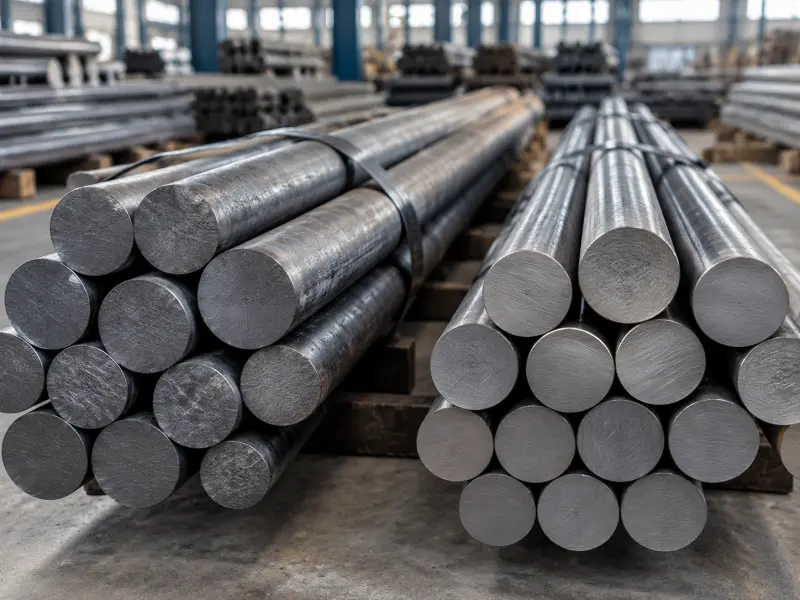
4130 vs 4140 steel is a common material comparison when selecting chromium-molybdenum alloy steel for mechanical components, welded structures, and industrial applications. The main differences lie in carbon content, hardenability, achievable strength, and weldability.
4130 is often considered when weldability and balanced mechanical properties are important, while 4140 is widely used for components requiring higher strength and hardness after suitable heat treatment.
4130 vs 4140 Steel: Key Differences
| Property | AISI 4130 Steel | AISI 4140 Steel |
|---|---|---|
| Steel type | Chromium-molybdenum alloy steel | Chromium-molybdenum alloy steel |
| Carbon content | 0.28–0.33% | 0.38–0.43% |
| Manganese content | 0.40–0.60% | 0.75–1.00% |
| Hardening potential | Moderate to high | Generally higher |
| Strength and hardness | Depends on heat treatment | Can achieve higher values with suitable heat treatment |
| Weldability | Generally better | Requires more careful welding control |
| Typical applications | Welded structures, tubing, mechanical components | Shafts, gears, heavy-duty machinery components |
When comparing 4140 vs 4130 steel, the main consideration is whether the application needs greater hardening potential or places more emphasis on weldability. Actual strength depends on material condition, dimensions, and heat treatment—not grade alone.
4130 vs 4140 Steel: Chemical Composition
The chemical composition of 4130 vs 4140 alloy steel explains much of the difference in hardening potential and mechanical performance.
| Element | AISI 4130 (%) | AISI 4140 (%) |
|---|---|---|
| Carbon (C) | 0.28–0.33 | 0.38–0.43 |
| Manganese (Mn) | 0.40–0.60 | 0.75–1.00 |
| Silicon (Si) | 0.15–0.35 | 0.15–0.35 |
| Chromium (Cr) | 0.80–1.10 | 0.80–1.10 |
| Molybdenum (Mo) | 0.15–0.25 | 0.15–0.25 |
| Phosphorus (P) | 0.035 max. | 0.035 max. |
| Sulfur (S) | 0.040 max. | 0.040 max. |
Typical reference ranges; confirm the applicable material specification before ordering.
The higher carbon and manganese contents of 4140 generally support greater hardenability. Both grades contain chromium and molybdenum, which contribute to hardenability and mechanical performance.
4130 vs 4140 Steel Properties: Strength and Hardness
The 4130 vs 4140 steel properties comparison depends on delivery condition, heat treatment, and product dimensions. The following table summarizes their general characteristics without treating condition-dependent values as universal.
| Mechanical property | 4130 Steel | 4140 Steel |
|---|---|---|
| Tensile strength | Depends on condition | Can achieve higher values after suitable heat treatment |
| Yield strength | Depends on condition and product size | Depends on condition and product size |
| Hardness | Suitable for varied hardness requirements | Generally higher hardening potential |
| Toughness | Good balance of strength and toughness | Can provide high strength and toughness when properly treated |
| Machinability | Depends on hardness and condition | Depends on hardness and condition |
For 4140 vs 4130 steel properties, compare materials in equivalent delivery and heat treatment conditions. 4140 is often preferred for higher-strength mechanical parts, while 4130 can meet many requirements where weldability and balanced properties are priorities.
4130 vs 4140 Steel: Heat Treatment and Weldability
Both grades can be annealed, normalized, or quenched and tempered, depending on the required properties. In 4130 vs 4140 steel heat treatment, 4140 generally offers greater hardening potential because of its higher carbon content.
| Consideration | 4130 | 4140 |
|---|---|---|
| Heat treatment | Used to adjust strength, hardness, and toughness | Used to achieve higher strength and hardness where required |
| Welding | Generally easier to weld | Requires more careful procedure control |
| Preheating | Depends on thickness, condition, and welding procedure | Often particularly important because of increased cracking risk |
| Post-weld treatment | Depends on application and specification | May be required depending on application and specification |
Welding procedures should account for material thickness, heat input, cooling rate, and the required final properties. Neither grade should be selected for a welded component without assessing the applicable welding requirements.
4130 vs 4140 Steel: Applications and Selection
| Application | Grade to consider | Main reason |
|---|---|---|
| Welded mechanical structures | 4130 | Weldability and balanced mechanical properties |
| Tubing and fabricated components | 4130 | Strength combined with fabrication requirements |
| Shafts and axles | 4140 | Higher strength and hardness potential |
| Gears and heavy-duty machinery parts | 4140 | Suitable response to heat treatment |
| General mechanical components | Both | Selection depends on specified properties |
For 4130 steel vs 4140, the decision should follow the actual operating requirements. Choose 4130 when its mechanical properties meet the design requirements and welding is important. Consider 4140 when higher strength or hardness is needed after suitable heat treatment.
Neither grade is universally better; the appropriate choice depends on loading, component design, fabrication, and service conditions.
Available Forms and Purchasing Considerations for 4130 and 4140 Steel
When sourcing 4130 or 4140 steel, confirm the following before requesting a quotation:
- Grade and standard: AISI 4130 or AISI 4140, with the applicable specification.
- Product form: 4130 and 4140 steel are available in round bar, flat bar, steel plate, steel sheet, and seamless steel tube forms, subject to grade-specific availability and applicable specifications.
- Dimensions: Diameter, thickness, length, and dimensional tolerances.
- Delivery condition: Annealed, normalized, quenched and tempered, or another specified condition.
- Mechanical requirements: Tensile strength, yield strength, hardness, and testing requirements.
- Documentation: Mill test certificate and other required inspection records.
The key difference in 4130 vs 4140 steel is their balance of hardening potential, mechanical properties, and weldability. Match the grade to the application requirements before finalizing the material specification.
For specific product requirements, explore our Alloy Steel Round Bar and Alloy Steel Plate options to compare available grades, dimensions, and delivery conditions.