
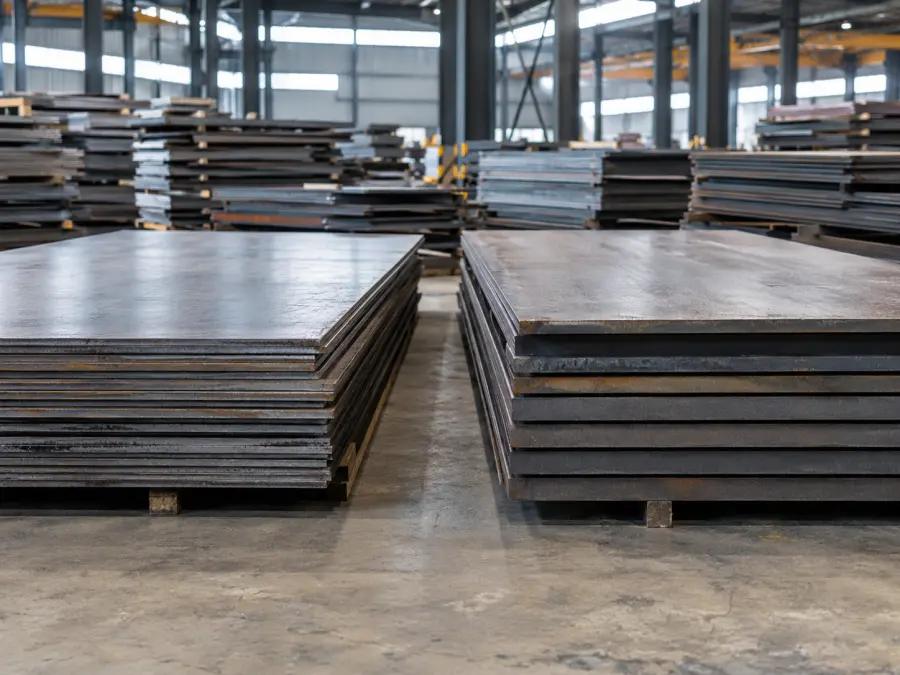
ASTM A36 and ASTM A572 are both widely used structural steels, but they are designed for different strength requirements.
This article focuses on A36 vs A572 Grade 50, a commonly specified grade within the ASTM A572 family. The main difference is straightforward: A572 Grade 50 provides higher specified strength, while A36 is widely used for general structural applications.
For steel buyers, the right choice depends on the required strength, project specification, plate dimensions, application, quantity and material availability.
A36 vs A572 Grade 50: Key Differences at a Glance
ASTM A572 includes several grades, including Grades 42, 50, 55, 60 and 65. For this comparison, A572 Grade 50 is the relevant grade.
| Factor | ASTM A36 | ASTM A572 Grade 50 |
|---|---|---|
| Steel type | General structural carbon steel | High-strength structural steel |
| Minimum yield strength* | 250 MPa | 345 MPa |
| Tensile strength* | 400–550 MPa | ≥450 MPa |
| Typical selection | General structural fabrication | Higher-strength structural applications |
| Common forms | Steel plate and structural products | Steel plate and structural products |
| Main advantage | Practical for standard structural requirements | Higher strength for demanding structural requirements |
*Typical minimum requirements for commonly supplied plate; applicable requirements should be confirmed against the relevant ASTM specification and thickness.
In simple terms:
- A36 → a practical choice for general structural steel requirements.
- A572 Grade 50 → a better choice when higher yield strength is required.
- The project specification should always determine the final grade selection.
A36 vs A572 Grade 50 Strength Comparison
The biggest difference in the A36 vs A572 strength comparison is yield strength.
| Mechanical Property | ASTM A36 | ASTM A572 Grade 50 |
|---|---|---|
| Yield Strength | ≥250 MPa | ≥345 MPa |
| Tensile Strength | 400–550 MPa | ≥450 MPa |
A572 Grade 50 has a minimum yield strength of 345 MPa, compared with 250 MPa for A36.
This higher strength makes A572 Grade 50 suitable when a structural component needs to carry higher loads or when the project specification calls for high-strength structural steel.
Which strength level is right for your project?
Choose A36 when:
- Standard structural strength is sufficient
- The project specification calls for A36
- The application involves general structural fabrication
- Standard steel plate supply is preferred
Consider A572 Grade 50 when:
- Higher yield strength is required
- The project specification calls for A572 Grade 50
- Strength is an important design factor
- Higher-strength structural steel is preferred
A36 vs A572 Chemical Composition
The A36 vs A572 chemical comparison is less important for most buyers than the mechanical requirements, but the two ASTM specifications control chemical composition differently.
The applicable limits can depend on the product form and specification requirements. For purchasing, the key point is to confirm that the supplied material meets the required ASTM grade and is supported by the applicable material documentation.
For detailed chemistry requirements, buyers should check the specific ASTM specification and material certificate rather than relying on a generic chemistry comparison.
A36 vs A572 Steel Plate: Which One Should You Choose?
For buyers comparing A36 vs A572 plate, the decision is mainly based on the required strength and project specification.
| Requirement | Recommended Choice |
|---|---|
| General structural steel plate | A36 |
| Standard structural fabrication | A36 |
| Higher yield strength | A572 Grade 50 |
| Strength-sensitive structural components | A572 Grade 50 |
| Project specification requires A36 | A36 |
| Project specification requires A572 Grade 50 | A572 Grade 50 |
The choice should not be based on grade name alone. Confirm the required grade, thickness, dimensions, mechanical properties and application before purchasing.
For projects requiring general structural steel plate, A36 can be a practical option. For higher-strength requirements, A572 Grade 50 may provide a better fit.
A36 vs A572 Cost and Procurement Considerations
There is no single fixed A36 vs A572 cost or A36 vs A572 price difference that applies to every order.
The actual purchasing cost can be affected by:
- Steel grade
- Plate thickness
- Width and length
- Order quantity
- Stock availability
- Processing requirements
- Delivery destination
A572 Grade 50 may have different material costs from A36, but buyers should evaluate the required strength and total procurement requirements, rather than selecting a grade based only on material price.
For a quotation, provide the required grade, thickness, width, length and quantity so the available supply options can be checked.
A36 vs A572 for Structural Steel Applications
Both grades can be used for structural fabrication, but their typical selection priorities are different.
When A36 Is a Practical Choice
A36 is commonly considered when the project requires:
- General structural steel plate
- Standard fabrication materials
- Structural components with conventional strength requirements
- Material specified as ASTM A36
It is a practical option when higher-strength steel is not required by the design or project specification.
When A572 Grade 50 Is a Better Choice
A572 Grade 50 is more suitable when:
- Higher yield strength is required
- The project specification identifies A572 Grade 50
- Structural strength is a key selection factor
- Higher-strength steel is preferred for the application
The higher specified yield strength is the main reason buyers choose A572 Grade 50 over A36.
For an overview of steel plate grades used in construction, see our Steel Plates for Construction guide.
A36 vs A572 Welding and Fabrication Considerations
Both A36 and A572 Grade 50 can be welded and fabricated for structural applications when appropriate procedures and consumables are used.
Because A572 Grade 50 has higher strength requirements, welding procedures, filler materials and other fabrication requirements should be selected according to the applicable project specification, material thickness and qualified welding procedure.
For buyers, the practical approach is to confirm the required grade and fabrication requirements before ordering rather than treating the two grades as interchangeable.
A36 vs A572: Which Steel Should You Buy?
The choice between A36 and A572 Grade 50 can be summarized simply:
| If your priority is… | Consider |
|---|---|
| General structural applications | A36 |
| Standard structural steel plate | A36 |
| Higher yield strength | A572 Grade 50 |
| Strength-sensitive applications | A572 Grade 50 |
| Project specification requires A36 | A36 |
| Project specification requires A572 Grade 50 | A572 Grade 50 |
Need A36 or A572 Grade 50 Steel Plate?
If you are sourcing ASTM A36 steel plate or A572 Grade 50 steel plate, send us your required grade, thickness, width, length and quantity.
We can check suitable supply options based on your specification, stock availability and purchasing requirements, and provide a quotation accordingly.