
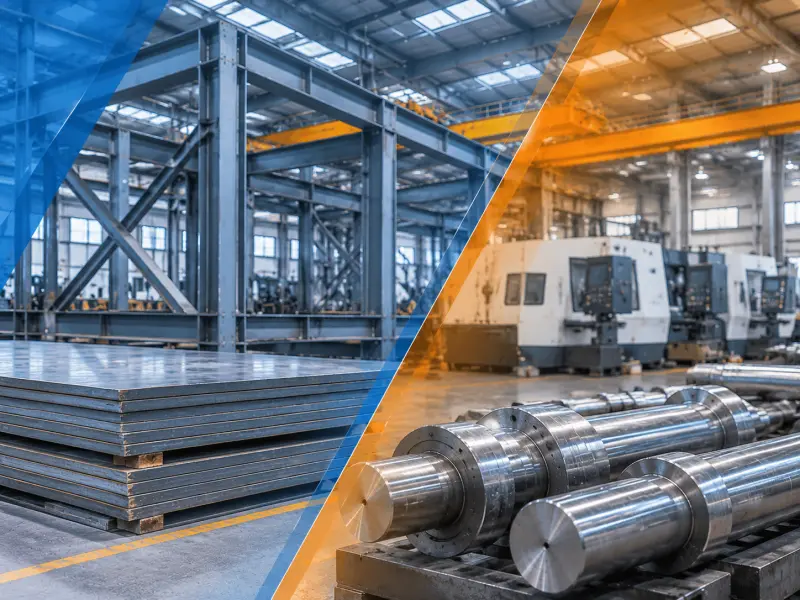
When comparing 1045 vs A36 steel, buyers need to consider carbon content, tensile strength, hardness, weldability and heat treatment requirements. Although both are carbon steels, they serve different purposes in structural fabrication and mechanical manufacturing.
A36 vs 1045 steel is primarily a comparison between low-carbon structural steel and medium-carbon steel. A36 is commonly selected for welded structures and general fabrication, while 1045 is preferred for machined components requiring higher strength and hardness potential.
This guide compares 1045 steel vs A36 across their key properties, helping buyers identify the right grade for their applications.
A36 vs 1045 Steel: Quick Comparison
The main differences between A36 vs 1045 steel are carbon content, mechanical properties and fabrication suitability. The table below summarizes the key specifications and performance characteristics.
| Property | ASTM A36 Steel | AISI 1045 Steel |
|---|---|---|
| Steel classification | Low-carbon structural steel | Medium-carbon steel |
| Carbon content | 0.25% max | 0.43–0.50% |
| Manganese content | 0.80–1.20%* | 0.60–0.90% |
| Tensile strength | 400–550 MPa* | Approx. 570–700 MPa |
| Yield strength | 250 MPa min* | Condition dependent |
| Hardness | Generally lower | Generally higher |
| Heat treatment | Limited hardening response | Suitable for quenching and tempering |
| Weldability | Good | Requires more control |
| Machinability | Good | Good, condition dependent |
| Main applications | Structural frames, brackets, welded components | Shafts, gears, machine parts |
Notes: A36 strength and composition requirements depend on product form and thickness. The tensile strength and yield strength figures shown are common structural plate requirements. 1045 mechanical properties vary with delivery condition and heat treatment. Its tensile strength range is indicative, not a universal specification requirement.
Key takeaway: In the comparison of 1045 vs A36 steel, A36 is generally more suitable for structural fabrication, while 1045 offers greater hardening potential for mechanical components.
1045 vs A36 Steel: Chemical Composition Differences
The most important chemical difference in 1045 steel vs A36 is the carbon content. A36 has a lower carbon limit, whereas AISI 1045 contains approximately 0.43–0.50% carbon. This difference influences strength potential, hardness, heat treatment response and weldability.
| Chemical Element | ASTM A36 (%) | AISI 1045 (%) |
|---|---|---|
| Carbon (C) | 0.25 max* | 0.43–0.50 |
| Manganese (Mn) | 0.80–1.20* | 0.60–0.90 |
| Silicon (Si) | Not universally specified | 0.10–0.30 |
| Phosphorus (P) | 0.040 max | 0.040 max |
| Sulfur (S) | 0.050 max | 0.050 max |
Note: A36 chemical composition limits vary by product form and thickness. The manganese range shown applies to commonly specified structural plate thicknesses.
Key differences between A36 steel and 1045 steel:
- Carbon content: 1045 contains significantly more carbon than A36, providing greater hardening potential.
- Hardness: The higher carbon content of 1045 makes it more suitable for applications requiring heat-treated hardness.
- Weldability: A36 generally offers better weldability because of its lower carbon content.
- Heat treatment: 1045 can be quenched and tempered to achieve different mechanical properties, while A36 has a limited response to conventional hardening treatments.
For buyers comparing A36 steel vs 1045, carbon content is an important starting point, but the final selection should also account for the required mechanical properties and fabrication process.
A36 vs 1045 Steel: Strength and Hardness Comparison
One of the most common reasons to compare 1045 vs A36 steel is the difference in strength and hardness. Although both grades are used in industrial applications, their mechanical performance and heat treatment capabilities are different.
| Mechanical Property | A36 Steel | 1045 Steel |
|---|---|---|
| Yield strength | 250 MPa min* | Depends on delivery condition |
| Tensile strength | 400–550 MPa* | Approx. 570–700 MPa |
| Brinell hardness | Typically around 119–159 HB | Varies with condition |
| Hardening response | Limited | Good |
| Quenching and tempering | Not a typical application | Suitable |
The A36 values refer to common structural plate thickness requirements. Hardness figures are indicative rather than ASTM A36 acceptance limits.
How does 1045 vs A36 steel strength compare?
- Tensile strength: 1045 generally provides higher tensile strength, depending on its delivery and heat treatment condition.
- Yield strength: A36 has a specified minimum yield strength for common structural plate thicknesses. 1045 yield strength varies with its condition.
- Hardness: 1045 can achieve substantially higher hardness through suitable heat treatment.
- Strength consistency: A36 is commonly purchased against structural specification requirements, while 1045 mechanical properties should be confirmed according to the required supply condition.
When comparing A36 vs 1045 steel hardness, 1045 has a clear advantage in hardening potential. However, higher hardness is not always the main requirement for structural steel applications.
1045 vs A36 Steel: Weldability and Machinability
Another important difference between A36 and 1045 steel is their response to welding and machining. The higher carbon content of 1045 makes welding more demanding, while A36 is generally easier to fabricate.
| Fabrication Factor | A36 Steel | 1045 Steel |
|---|---|---|
| Weldability | Good | More challenging |
| Preheating | Depends on thickness and welding procedure | Often required depending on conditions |
| Hydrogen control | Required according to welding procedure | Particularly important |
| Post-weld treatment | Application dependent | May be required |
| Machinability | Good | Good, condition dependent |
| Heat treatment | Limited hardening capability | Suitable for hardening and tempering |
Welding: For buyers evaluating A36 vs 1045 steel for welding, A36 is generally the easier option for conventional structural fabrication. Welding 1045 requires greater control of preheating, hydrogen levels and cooling conditions to reduce cracking risks.
Machining: Both grades can be machined, but their applications differ. 1045 is often selected for shafts, gears and mechanical components where machining is followed by heat treatment. A36 is more commonly used for cutting, drilling and fabrication of structural components.
Therefore, 1045 vs A36 steel weldability and machining requirements should be considered alongside mechanical properties when specifying material for production.
A36 vs 1045 Steel: Applications and Material Selection
The application differences between A36 vs 1045 steel mainly come from their strength characteristics, hardness potential and fabrication requirements.
| Application | Recommended Grade | Main Reason |
|---|---|---|
| Structural steel frames | A36 | Structural strength and weldability |
| Welded brackets and supports | A36 | Easier fabrication |
| General steel fabrication | A36 | Suitable for structural components |
| Machinery shafts and axles | 1045 | Higher strength and hardness potential |
| Gears and mechanical components | 1045 | Suitable for machining and heat treatment |
| Components requiring hardening | 1045 | Better heat treatment response |
| General structural plates | A36 | Established structural steel grade |
When to choose A36 over 1045:
- Structural projects requiring conventional steel plates and sections.
- Components involving extensive welding and fabrication.
- Applications where structural specification compliance is the priority.
When to choose 1045 over A36:
- Mechanical parts requiring higher hardness potential.
- Shafts, axles and gears requiring machining.
- Components that will undergo quenching and tempering.
- Applications where the mechanical properties of medium-carbon steel are more suitable.
The choice between 1045 steel vs A36 should be based on the finished component’s requirements, rather than simply selecting the grade with the higher tensile strength.
1045 vs A36 Steel: Which One Should You Choose?
The best choice between 1045 vs A36 steel depends on whether the priority is structural fabrication or mechanical performance.
| Purchasing Requirement | Recommended Grade |
|---|---|
| Structural steel plates and sections | A36 |
| General welded fabrication | A36 |
| Good weldability | A36 |
| Higher carbon content | 1045 |
| Higher hardness potential | 1045 |
| Quenching and tempering | 1045 |
| Machined shafts and mechanical parts | 1045 |
In summary, A36 vs 1045 steel is not a direct competition between two interchangeable materials. A36 is generally the better choice for structural fabrication and welded components, while 1045 is more suitable for mechanical parts requiring higher hardness and heat treatment.
At Shuang’ao, we supply carbon steel products for structural and industrial applications. Explore our [A36 steel] and [1045 steel] supply options for different material requirements.
When requesting a quotation, specify the required grade, product form, dimensions, quantity and delivery condition to help confirm the appropriate material for your project.